

Pottery
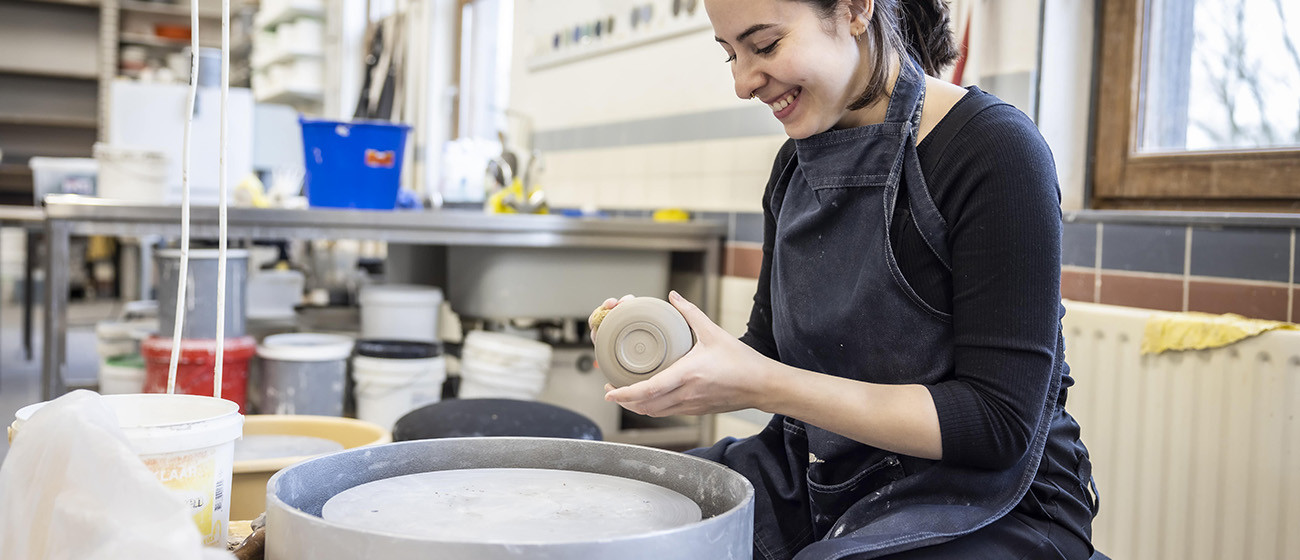
Pottery is a form of ceramics we come across every single day in items as teacups, soup bowls, jars, and vases. All these round shapes are made by throwing clay on a turning table before the clay is fired in the kiln at a minimum temperature of 1000 ˚C, after which it can be decorated and glazed. Pottery requires a lot of practice, but it’s an art that allows you to develop your own personal style.
Course levels
The Pottery course for beginners teaches you the basics of the art of pottery. You learn to throw clay on an electric turn table and work on your own design such as a cup or pot. You will practice until you’ve mastered the technique and are able to shape the clay into the object you have in mind. Following the drying process, your creation will be baked at a minimum of 1,000 degrees, after which you can make a selection from a wide range of glazes to decorate your work. Your work will be finished and ready to use after the second baking.
After this course for beginners, you can continue with the intermediate course after which you have access to our Open Studio program where you can work on your own projects and continue to experiment.
The intermediate Pottery course teaches you the art of pottery. You learn about the techniques to control your clay on the electric wheel better so that your designs are straight and symmetrical. You work on your own design, where there's plenty of room to experiment. If you have worked on the electrical wheel before, you can join this course.
You will practice until you’ve mastered the technique and are able to shape the clay into the object you have in mind. Following the drying process, your creation will be baked at a minimum of 1,000 degrees, after which you can make a selection from a wide range of glazes to decorate your work. Your work will be finished and ready to use after the second baking.
After this intermediate course, you have access to our Open Studio program where you can work on your own projects and continue to experiment.
Teachers
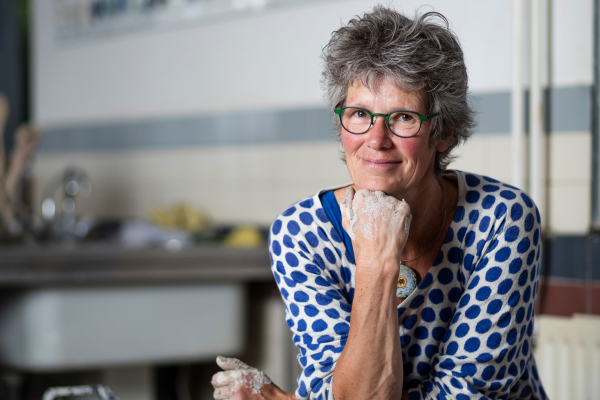
Beginners Florian studied Product Design at Bauhaus University in Weimar, Germany. During his exchange studies at the Pratt Institute in New York, he developed an interest in ceramics. He gained teaching experience by conducting workshops with the turntable. Now he studies Strategic Product Design at TU Delft and is Open Studio Assistant at X's pottery. Intermediate Ellen studied at the school of Arts in Kampen and the Dutch Ceramics Academy in Gouda. Since 1991 she has been working as an independent ceramist.She sells her ceramic objects all over Europe and in China. She has been a teacher in ceramics since 1992 and worked at different organisations like the Dutch Ceramics Academy in Gouda, VAKDelft and X.Florian Henschel

Florian Henschel
Ellen Rijsdorp
Ellen Rijsdorp
Practical information
The course includes basic materials and enough clay and glaze to create your first piece of work. If you have time to work on more pieces, you can purchase more clay and other materials during the course. Wear old clothes or bring an apron to the lessons, if you like, and don't be afraid of getting your hands dirty.
Rooster laden...
Subscriptions & tickets
Log in to see your price
Log in to see your price